Supplier management: supplier selection, supplier evaluation and supplier development
- Supplier management means selecting the right partners, evaluating their performance and developing them in a targeted way.
- Supplier selection works like a funnel: from many candidates through questionnaires to an on-site audit.
- Supplier evaluation compares the performance delivered (actual) with the performance agreed (target), for example in logistics, technology, quality and price.
- Supplier development works preventively before the collaboration starts, or correctively when problems arise.
In our series on procurement we have already looked at purchasing (Part 1 - Procurement vs. purchasing), the procurement process (Part 2 - Procurement process), goods receipt (Part 3 - Goods receipt) and the various sourcing concepts (Part 4 - Sourcing concepts).
In this article we take a close look at supplier management, and you will learn all about the individual phases of the supplier lifecycle. Watch the video (part 5) for this article on our YouTube channel.
Playing the video transfers data to YouTube (Google). Privacy policy ·
What does supplier management cover?
Supplier management plays a central role in procurement. The best ordering process and a highly optimised goods receipt are of no use if you have selected the wrong suppliers beforehand. So what is supplier management in the first place?
"The task of supplier management is to select the right partners (in a network) for a company, to evaluate the suppliers' performance and to increase their performance through development." - (Kuhlang et al., 2010)
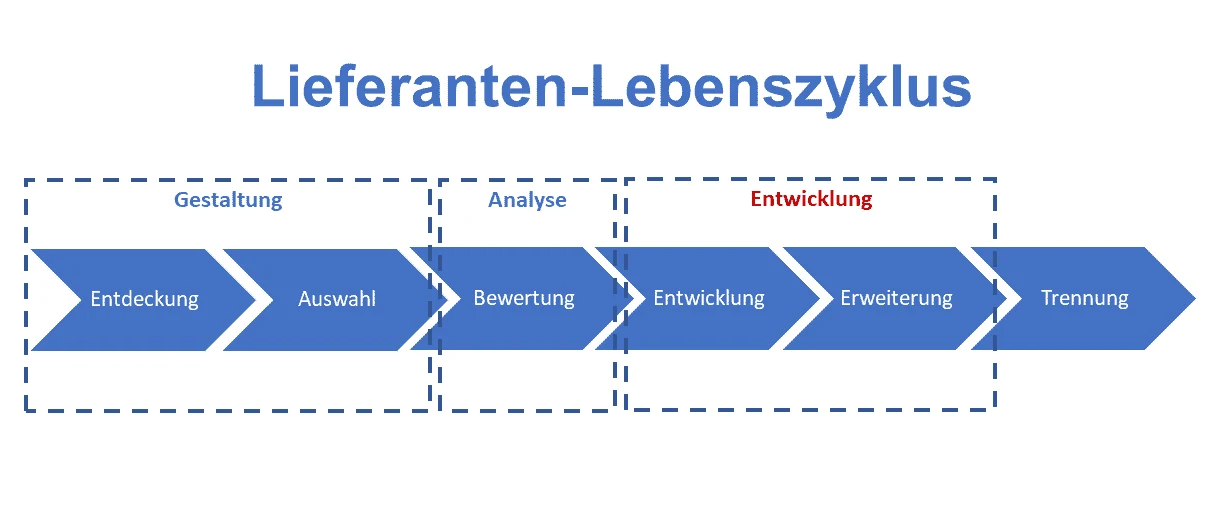
So it is important to find the right partners and to keep increasing their performance. The relationship with a supplier runs within the supplier lifecycle. This can be roughly divided into the phases of design, analysis and development:
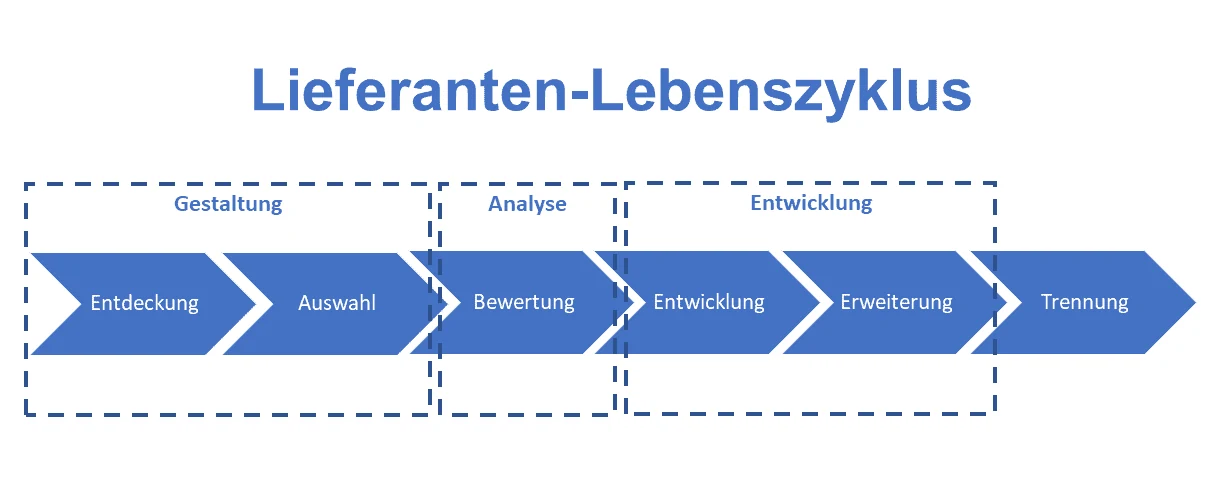
- In the design phase, suppliers are first discovered and then selected
- After the evaluation in the analysis phase, the supplier relationships are then continuously developed further in the development phase
- The lifecycle with a supplier finally ends with separation
What are the benefits of supplier management?
- higher supply quality
- lower process and failure costs through cross-company planning
- lower transaction costs
- faster resolution of problems that arise with the supplier
- more efficient introduction of standards across the supply chain
Source: Kuhlang et al., 2010
Supplier selection
Now that we have a good overview of supplier management, we will next look more closely at supplier selection, supplier evaluation and supplier development.
How supplier selection works Supplier selection corresponds to the "design" phase of the lifecycle discussed above. This means suppliers are discovered and selected. The tasks of supplier selection include identifying and selecting suitable suppliers (selection), selecting them again (re-selection) or excluding them (de-selection).
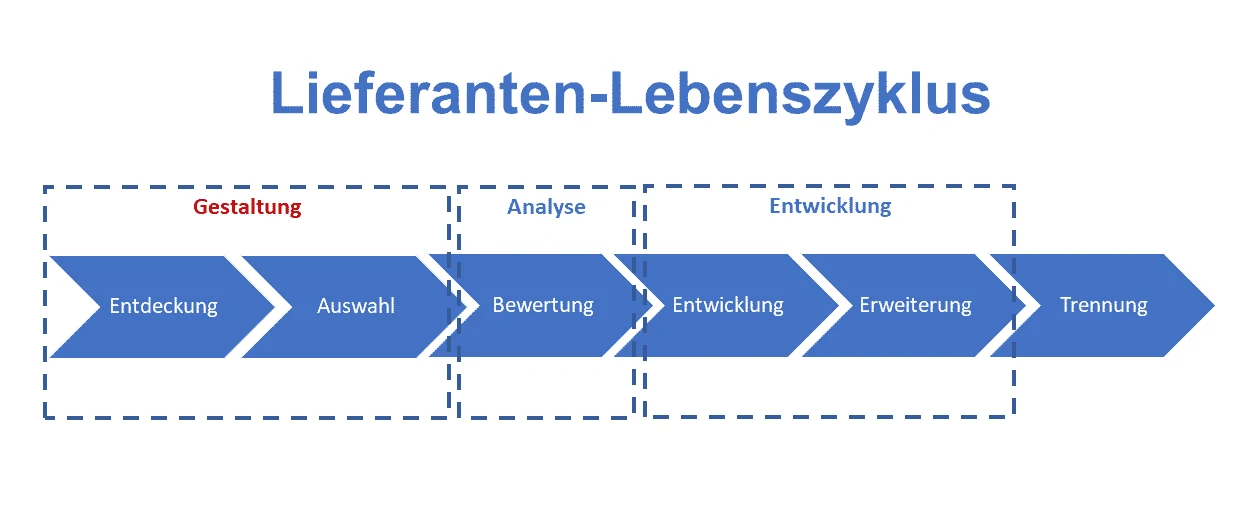
The basis for successful supplier selection is that the procurement strategy has been defined beforehand. The search for potential suppliers continues until:
- no further sources of supply can be found
- no further benefit can be expected, or
- there is no time left for further research
Source: Kuhlang et al., 2010
To end up with suitable suppliers, multi-stage procedures are often used. As with a funnel, you start with a relatively large number of potential suppliers. The field is then narrowed down step by step. You often start with publicly or easily accessible information, or with questionnaires. Later in the process you may well turn to more elaborate on-site visits for audits. This of course assumes that the article in question is of corresponding strategic importance.
Methods such as price decision analyses, checklists or scoring systems with different weightings can be used for supplier selection.
What different types of procedures are there for supplier selection? The procedures used can basically be divided into quantitative and qualitative procedures.
Quantitative procedures include, for example:
- balance sheet analysis
- price and cost decision analyses, and
- key figure methods
Source: Kuhlang et al., 2010
Qualitative procedures include, among others:
- utility analysis
- profile and portfolio analyses
- checklist methods, and
- scoring methods
Source: Kuhlang et al., 2010
Which criteria matter most when selecting a supplier? Traditionally the strongest criterion is price. This total price is made up of the price of the part being procured plus the logistics costs. Besides price, quality is also an important characteristic. Factors such as regionality and market power can also play an interesting role.
In supplier selection it is important to store the collected data and information in a structured way, so that they can be aggregated and analysed. Simple tools such as Excel or specific tools can be used for this. Some ERP systems also offer ways to store and analyse this information.
Supplier evaluation
What is meant by supplier evaluation? In supplier evaluation, the supplier's performance delivered (the actual state) is compared with the performance agreed (the target state). Various methods and procedures are used for the evaluation. The evaluation can take place continuously, at regular intervals or on an event basis.
Why do you need supplier evaluation at all? Supplier evaluation provides a basis for decisions. On that basis, further measures are taken with the supplier to secure the objectives. If the performance is not right, measures such as switching supplier or supporting the supplier in the form of supplier development naturally come into play.
Which criteria can be used to evaluate suppliers?
- Logistics: In logistics you can evaluate, for example, where the supplier is located, whether it can receive orders electronically via EDI (Electronic Data Interchange), what inventory it holds and how its production and procurement are set up in general
- Technology: From a technical point of view you can check what specific competences the supplier has in manufacturing, project management and development, and whether it has its own laboratories to test new things
- Quality: In quality you can evaluate whether the supplier holds certain certifications, how strong its quality and environmental awareness is, or how well its processes are documented
- Costs & prices: Last but not least, costs and prices. Here you can evaluate how transparently prices are arrived at, what the cost structure looks like, which controlling system is in use and what the state of rationalisation activities is
Source: Kuhlang et al., 2010
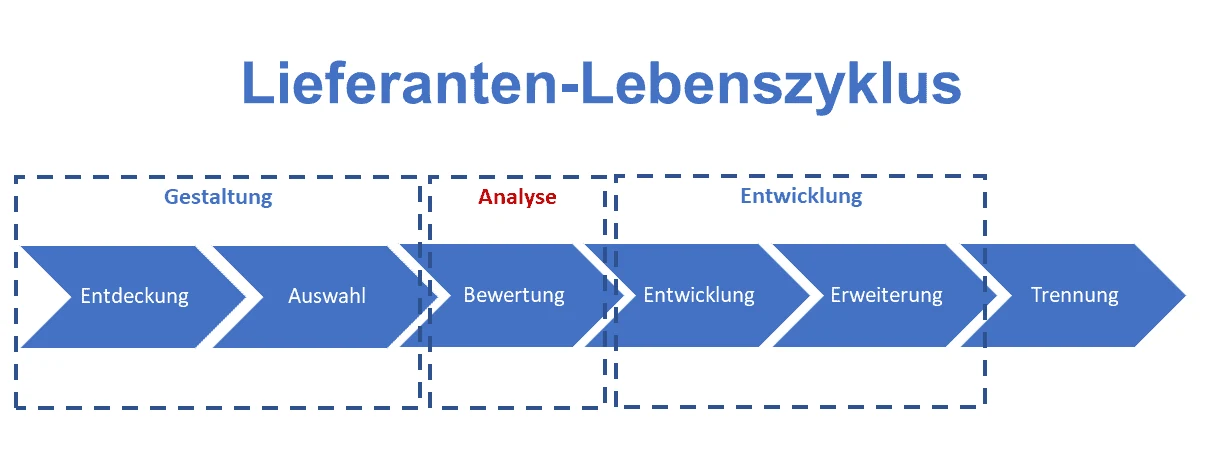
So what are the advantages of supplier evaluation? Now that we know what supplier evaluation is and in which areas it can be carried out, the only remaining question is what the advantages are for each of the partners involved.
For the supplier, supplier evaluation results in cost savings through avoiding errors, and longer-term contracts (provided it performs well enough), and with that more revenue and better predictability.
On the buyer side, supplier evaluation can lead to a reduction in inventory holding, a simplified goods receipt inspection and also risk minimisation.
However, you should always take care not to overdo supplier evaluation. That means evaluating only the most important criteria rather than all of them, using quantifiable criteria wherever possible, and always weighing up the pros and cons of the different procedures and methods.
Supplier development
What exactly is supplier development? "Active measures to increase suppliers' efficiency, in both the short-term and the long-term sphere of impact, are summarised under the term supplier development." - (Kuhlang et al., 2010)
These measures can be consulting, know-how transfer, but also financial support.
In supplier development, a distinction can be made between:
- preventive supplier development and
- corrective supplier development
In preventive supplier development, the aim is to get the supplier "fit" before the actual collaboration begins.
Measures of preventive supplier development can range from training the supplier, through involving the supplier in the planning process and communicating quality requirements and communication rules, to transparency of the supply chain and inventories, so that both sides are fully informed, can plan better and can react early. Read the blog article: Crisis-proof supplier management in difficult times
In corrective supplier development, a process is triggered when certain problems occur, with the aim of restoring quality.
As in a control loop, the current status is established first. If it deviates from the target state, concrete measures to solve the problem are derived from it. Finally, the effectiveness of these measures is checked. If the measures have not solved the problem, you go into the next round, analysing the current status again and deriving new measures.
Supplier audits and supplier reviews
Finally, we want to take a brief look at supplier reviews.
At least once a year, the results of the supplier evaluation should also be discussed with the supplier.
You can usually assume that the supplier will see one point or another differently. That is why it is important to bring to the meeting both the evaluation system used, including the scoring of the sub-criteria, and the hard data on which these results are based. It never hurts to bring colleagues from operational purchasing and quality management to the meeting as well, as they can explain the data accordingly. Clearly, given possible differences of opinion, great importance must be placed on good conflict management in such meetings. It is not just about "coming to terms with the past", but above all about clarifying how you want to shape the future together. If there are more serious problems, corresponding measures in the sense of corrective supplier development must also be agreed.
Supplier reviews only work if the supplier evaluation stands on solid ground. And that means the data basis. All relevant data must therefore be recorded regularly and be available for analysis. Many of the data points can be captured automatically by an ERP system or by specialised purchasing and inventory management tools such as EazyStock. This avoids recording errors on the one hand and, on the other, saves significant time otherwise spent on manual data entry.
In practice: Lederhosen AG
Let's look at the supplier lifecycle using our fictional company "Lederhosen AG". Lederhosen AG is a traditional mid-sized company that produces and sells traditional Alpine clothing such as lederhosen and dirndls. It has to supply its own retail shops as well as its online shop and retailers with products.
Lederhosen AG is currently expanding its range to include felt hats. As Lederhosen AG does not yet have suitable suppliers for the planned type of felt hats, it needs to find new suppliers.
In the design phase of the supplier lifecycle, potential suppliers are therefore first discovered and then selected. Lederhosen AG starts by collecting potential candidates and analysing them on the basis of publicly available information such as product range, location and the company's liquidity. This includes a balance sheet analysis and a look at various key figures of the potential suppliers.
All candidates that pass this first check are then contacted and sent a questionnaire to gather further information. The answers are then assessed in a utility analysis.
In the end, 3 potential candidates are still in the running. With these, Lederhosen AG arranges an on-site visit to tour the plant and explore the possibilities of working together in a workshop.
After these on-site visits there is a clear winner, which from now on will become the main supplier.
As part of supplier evaluation, Lederhosen AG defines the criteria by which it will regularly evaluate the new felt hat supplier. Besides price, Lederhosen AG is particularly concerned with the regional origin of the manufacturing and the raw materials. These are therefore among the most important criteria. It is also important that data is exchanged smoothly and automatically between Lederhosen AG's ERP system and the supplier's, so that no data has to be entered manually.
As Lederhosen AG wants to ensure the best possible start with new suppliers, the supplier is integrated closely into Lederhosen AG's processes through onboarding and receives appropriate training before the collaboration begins, as part of preventive supplier development.
If problems arise during the collaboration, the process of corrective supplier development is started automatically: the cause of the problem is identified, measures to solve it are agreed together with the supplier, and afterwards it is checked whether these measures have achieved the desired result.
By the way: Lederhosen AG holds an annual supplier review with the new supplier. Based on the data collected from the ERP system and other systems, the supplier's performance is measured and the results are discussed as part of the supplier evaluation. The Lederhosen AG staff involved are trained in conflict management to ensure that disagreements do not escalate and that the focus stays on the future collaboration.
In this way Lederhosen AG secures a long-term collaboration with the new supplier.
Frequently asked questions
Which criteria matter in supplier selection?
Traditionally the strongest criterion in supplier selection is price, understood as the total price of the procured part plus logistics costs. Quality is another important characteristic. Regionality and market power can also play a role.
The data collected should be stored in a structured way so that it can be aggregated and analysed, for example in Excel, in specific tools or in the ERP system.
Which methods are used for supplier selection?
Supplier selection methods can be divided into quantitative and qualitative procedures. Quantitative procedures include balance sheet analysis, price and cost decision analyses and key figure methods.
Qualitative procedures include utility analysis, profile and portfolio analyses, checklist procedures and scoring procedures, in which criteria can be given different weightings.
What are the steps in the supplier selection process?
The supplier selection process is usually multi-stage and works like a funnel. It builds on a previously defined procurement strategy. You start with a relatively large number of potential suppliers and narrow them down step by step: first using publicly or easily accessible information, then with questionnaires.
For strategically important items, more elaborate on-site visits with audits follow at the end.
How does supplier evaluation work?
Supplier evaluation compares the performance a supplier delivered (actual) with the performance agreed (target). It can cover areas such as logistics, technology, quality, and costs and prices. The evaluation can be permanent, at regular intervals or event-based.
It makes sense to evaluate only the most important criteria and to use quantifiable ones where possible. The results should be discussed with the supplier at least once a year.
What are the phases of supplier management?
Supplier management follows the supplier lifecycle with the phases of design, analysis and development. In the design phase, suppliers are discovered and selected, in the analysis phase they are evaluated, and in the development phase the relationship is continuously developed.
Supplier development works preventively before the collaboration starts, or correctively when problems arise. The lifecycle ends with separation from the supplier.